

What Is Rh Incompatibility in Pregnancy?
Every individual’s red blood cells carry surface proteins called antigens. One of the most critical blood group antigens is the Rhesus (Rh) D antigen. If your red blood cells possess this protein, you are Rh-positive (Rh+). If your red blood cells lack this protein, you are Rh-negative (Rh-). Approximately 85% of people worldwide are Rh-positive, and 15% are Rh-negative.
Being Rh-negative does not affect your individual health in any way. However, during pregnancy, a potential immunological conflict called Rh Incompatibility arises under one specific genetic combination:
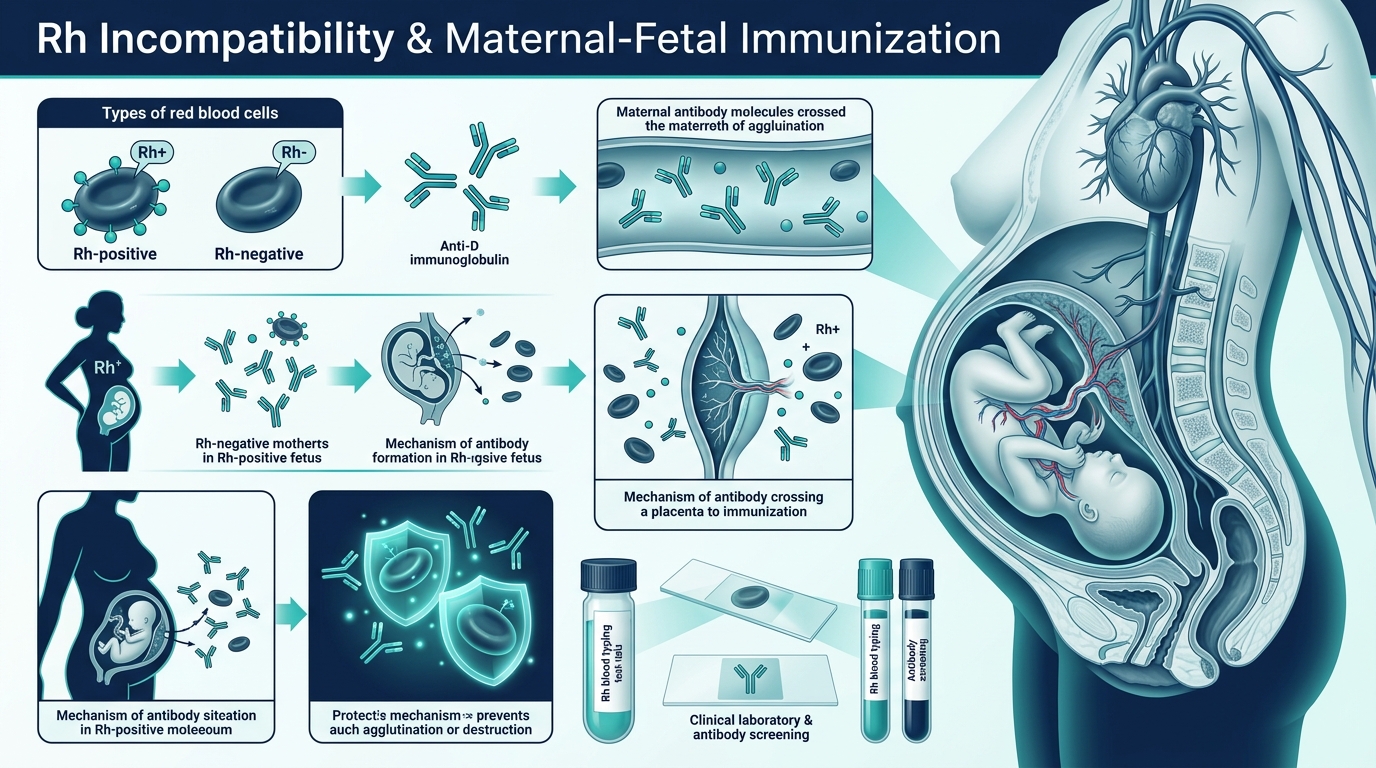
If fetal Rh-positive red blood cells leak into the Rh-negative mother’s bloodstream, her immune system identifies the Rh(D) protein as a foreign invader (antigen) and mounts an immune response, producing anti-Rh (anti-D) antibodies. This process is called Rh Isoimmunization (or Rh Alloimmunization).
The Mechanism: Why the First Baby Escapes, But Subsequent Pregnancies Face Attack
Under normal anatomical conditions, maternal blood and fetal blood do not mix directly. They are separated by the microscopic placental barrier, which permits oxygen, nutrients, and waste to diffuse between bloodstreams while keeping cellular components separated.
Fetomaternal hemorrhage typically occurs during labor, delivery, or placental separation. By the time the mother’s immune system recognizes the fetal Rh+ cells and synthesizes initial IgM antibodies, the baby is already born safely. However, maternal B-lymphocytes convert into permanent IgG memory cells.
If the mother conceives another Rh-positive fetus, even a microscopic drop (0.1 mL) of fetal blood stimulates a massive, rapid production of anti-D IgG antibodies. Unlike IgM, IgG antibodies easily cross the placenta, bind to fetal red cells, and trigger their destruction by macrophages in the fetal spleen.
Sensitization does not only happen during childbirth. An Rh-negative woman can become sensitized at any stage of pregnancy if an event causes fetomaternal hemorrhage:
- Spontaneous miscarriage or threatened abortion with vaginal bleeding
- Elective or medical termination of pregnancy
- Ectopic or molar pregnancy
- Invasive prenatal diagnostic procedures (Amniocentesis, Chorionic Villus Sampling - CVS, Cordocentesis)
- Blunt maternal abdominal trauma (e.g. car collision, fall)
- External cephalic version (ECV) for breech presentation
- Manual removal of placenta or cesarean section
Essential Blood Tests to Check If Antibodies Already Exist in the Mother's Bloodstream
Before administering preventive injections, obstetricians perform precise laboratory assays to determine maternal Rh status, assess paternal genetics, and verify whether anti-D antibodies have already formed in the mother’s circulation.
| Test Name & Specimen | When Performed | Clinical Purpose | Result Meaning |
|---|---|---|---|
| Indirect Coombs Test (IAT)Indirect Antiglobulin Test (Maternal Serum) | 1st booking visit & repeated at 28 weeks | Detects free, circulating anti-D IgG antibodies in maternal blood. | Negative: Non-sensitized; eligible for RhoGAM. Positive: Sensitized; RhoGAM ineffective; high-risk protocol. |
| Maternal Anti-D TiterSerial Dilution Assay (Maternal Serum) | Every 2–4 weeks if Indirect Coombs is positive | Measures antibody concentration (1:2, 1:4, 1:8, 1:16, 1:32, etc.). | < 1:16: Low risk; continue serial monitoring. ≥ 1:16: Critical threshold; trigger MCA Doppler ultrasound. |
| ABO & RhD GroupingForward & Reverse Typing (EDTA Blood) | First prenatal visit (mother & father) | Verifies maternal Rh status (Rh- vs Rh+) and assesses paternal Rh zygosity (DD vs Dd). | If father is Rh-negative (dd), fetus is Rh-negative; pregnancy is completely safe from Rh disease. |
| Cell-Free Fetal DNA (cffDNA)Non-Invasive Prenatal Testing (Maternal Blood) | From 10 weeks gestation onward | Analyzes fetal DNA fragments in mother’s plasma to determine fetal RhD genotype non-invasively. | If fetus is RhD-negative, routine 28-week and postpartum RhoGAM can safely be avoided. |
| Direct Coombs Test (DAT)Direct Antiglobulin Test (Cord Blood) | Immediately after birth from umbilical cord | Detects maternal antibodies physically bound onto baby’s red blood cell surface. | Negative: No antibody coating. Positive: Infant at risk for acute neonatal jaundice/anemia. |
| Kleihauer-Betke (KB) TestAcid Elution Blood Smear / Flow Cytometry | Postpartum or after severe abdominal trauma | Quantifies volume of fetal red blood cells in maternal circulation. | Calculates whether additional vials of Anti-D (beyond standard 300 mcg) are required. |
Understanding the Indirect Coombs Test: Negative vs. Positive Results
The Indirect Coombs Test (Indirect Antiglobulin Test / IAT) is the clinical fork in the road for Rh-negative prenatal care:
What it means: There are NO anti-Rh antibodies in the mother’s bloodstream. The maternal immune system has not been triggered.
Clinical Action: The mother is a candidate for full Anti-D Immunoglobulin (RhoGAM) prophylaxis. She receives 300 mcg (1500 IU) at 28 weeks gestation, and another 300 mcg within 72 hours after delivery if the baby is confirmed Rh-positive. With this protocol, the chance of developing antibodies is reduced to less than 0.2% (99.8% effective).
What it means: The mother’s bloodstream ALREADY contains active anti-Rh(D) antibodies from a previous pregnancy, miscarriage, or blood transfusion.
Clinical Action: RhoGAM is NOT given. RhoGAM cannot erase or suppress antibodies that already exist. Instead, the pregnancy is classified as high-risk and managed by a Maternal-Fetal Medicine (MFM) specialist through serial antibody titers, middle cerebral artery (MCA) Doppler ultrasounds, and intrauterine fetal transfusions if required.
Anti-D Immunoglobulin (RhoGAM): Dosage, Timing & Clinical Protocol
Rho(D) Immune Globulin (commonly known by brand names such as RhoGAM, WinRho SDF, HyperRHO, or Anti-D) is a sterile immunoglobulin solution made from purified human plasma containing high titers of antibodies against the RhD factor.
How Does RhoGAM Work?
When given to an Rh-negative mother, the injected anti-D antibodies circulate in maternal blood and attach to any fetal Rh-positive red blood cells that have crossed the placenta. These coated fetal cells are quickly removed and destroyed by macrophages in the mother's spleen before maternal B-lymphocytes can identify the D antigen and create memory cells.
Standard Administration Schedule:
Dose: 300 mcg (1500 IU) IM. Administered routinely to all non-sensitized Rh-negative mothers because microscopic placental micro-leaks naturally increase in the 3rd trimester.
Dose: 300 mcg (1500 IU) IM. Given within 72 hours of delivery if newborn cord blood testing confirms that the baby is Rh-positive and Direct Coombs is negative.
ACOG and RCOG guidelines state that if Anti-D was inadvertently omitted within 72 hours of delivery or trauma, it should still be administered as soon as recognized, up to 28 days postpartum. Even late administration provides substantial protective benefit compared to no administration.
What Happens if Antibodies Attack? Hemolytic Disease of the Fetus and Newborn (HDFN)
When maternal anti-D IgG antibodies cross the placenta into an Rh-positive fetus, they bind to fetal RBCs and cause progressive hemolysis (rupture of red cells). This spectrum of disease includes:
Accelerated destruction of fetal red cells leads to severe oxygen deficit. Fetal bone marrow, liver, and spleen attempt compensatory extramedullary hematopoiesis (erythroblastosis fetalis).
Severe chronic anemia causes high-output fetal cardiac failure, hepatic dysfunction, hypoalbuminemia, and massive fluid accumulation in body cavities (ascites, pericardial effusion, severe skin edema).
In utero, the maternal placenta clears fetal bilirubin. After birth, the immature newborn liver cannot clear the massive surge of bilirubin produced by ongoing hemolysis.
Unconjugated bilirubin crosses the blood-brain barrier and deposits in the basal ganglia, leading to permanent neurological damage, cerebral palsy, sensorineural deafness, or death.
Modern Maternal-Fetal Medicine Management for Sensitized Mothers
If an Indirect Coombs test is positive, obstetricians have revolutionized care over the past two decades, replacing historic invasive amniotic bilirubin tests (Liley curves) with modern non-invasive technologies:
Middle Cerebral Artery (MCA) Doppler Peak Systolic Velocity (PSV)
When blood is thin and anemic, it flows with lower viscosity and higher speed. Color Doppler ultrasound measures the peak systolic velocity (PSV) of blood flowing through the fetal middle cerebral artery. An MCA-PSV greater than 1.5 multiples of the median (MoM) reliably predicts moderate-to-severe fetal anemia with over 95% sensitivity.
Frequently Asked Clinical Questions (FAQs)
Can an Rh-negative mother have a healthy baby?
Yes, absolutely. With modern antenatal screening (Indirect Coombs testing) and timely Anti-D Immunoglobulin (RhoGAM) prophylaxis, over 99.8% of Rh-negative women give birth to completely healthy babies without any complications from Rh incompatibility.
What if the father of the baby is also Rh-negative?
If both biological parents are Rh-negative (dd and dd), their baby can only inherit Rh-negative alleles and will 100% be Rh-negative. In this scenario, Rh incompatibility is biologically impossible, and RhoGAM injections are not strictly necessary once paternity and blood typing are confirmed.
Does RhoGAM harm my baby during pregnancy?
No. RhoGAM is a purified human plasma product that has been used safely in millions of pregnancies worldwide for over 50 years. It does not harm fetal growth, does not cause congenital defects, and is safe during breastfeeding.
What happens if I miss the 72-hour window after delivery or miscarriage?
Contact your obstetrician immediately. While within 72 hours is the optimal standard window, international guidelines recommend administering Anti-D as soon as possible, up to 14 to 28 days following the sensitizing event. Late administration is vastly superior to no administration.
What is the difference between Direct and Indirect Coombs tests?
The Indirect Coombs test (IAT) is performed on maternal blood to detect unattached antibodies circulating in her serum. The Direct Coombs test (DAT) is performed on newborn cord blood to check if maternal antibodies have already adhered to the baby’s red blood cell surface.
Why can’t RhoGAM be given if the Indirect Coombs test is already positive?
RhoGAM works as passive prophylaxis by binding to and clearing stray fetal cells before maternal memory cells are created. If the mother is already sensitized (positive Coombs test), her immune system already possesses endogenous antibody-producing plasma and memory cells. Injected RhoGAM cannot reverse or dismantle an active immune response.
- American College of Obstetricians and Gynecologists (ACOG). Practice Bulletin No. 181: Prevention of Rh D Alloimmunization. Obstetrics & Gynecology. 2017;130(2):e57-e70.
- Royal College of Obstetricians and Gynaecologists (RCOG). The Use of Anti-D Immunoglobulin for Rhesus D Prophylaxis. Green-top Guideline No. 22. 2020.
- World Health Organization (WHO). Guidelines for the Management of Hemolytic Disease of the Fetus and Newborn. Geneva: WHO; 2021.
- Federation of Obstetric and Gynaecological Societies of India (FOGSI). Clinical Practice Guidelines for Management of Rh-Negative Pregnancy. 2022.
The information provided on this website is for educational purposes only and is not intended as a substitute for professional medical advice, diagnosis, or treatment. Always seek the advice of a qualified healthcare provider with any questions you may have regarding a medical condition.